ORPHEUS now understands whole conversations
Nils Schweingruber
CEO & Mitgründer, IDM gGmbH
You talk to the patient, ORPHEUS writes it down. That's the leap from medical speech recognition to ambient documentation, and it's the heart of version 4.0. Alongside it come a new template library, ICD coding suggestions, and mobile apps for iPhone and Android.
Ambient: the conversation becomes the note
Ambient runs in the background. You start the recording once and have your conversation just as you normally would, with the patient, with their relatives, with your colleagues at the bedside. ORPHEUS listens without getting in the way.
Three things happen at once. ORPHEUS separates the speakers: who is the physician, who is the patient, who is the relative? From that dialogue, ORPHEUS builds a structured clinical note, based on the template you chose. And while you're still talking, ORPHEUS flags in real time what the template is still missing: the open question about medication, the value that hasn't come up yet, the finding that makes the note complete.
When the conversation ends, there's no audio track left for you to type up. There's a draft that already follows the structure of your documentation. You read it, correct it, sign off.
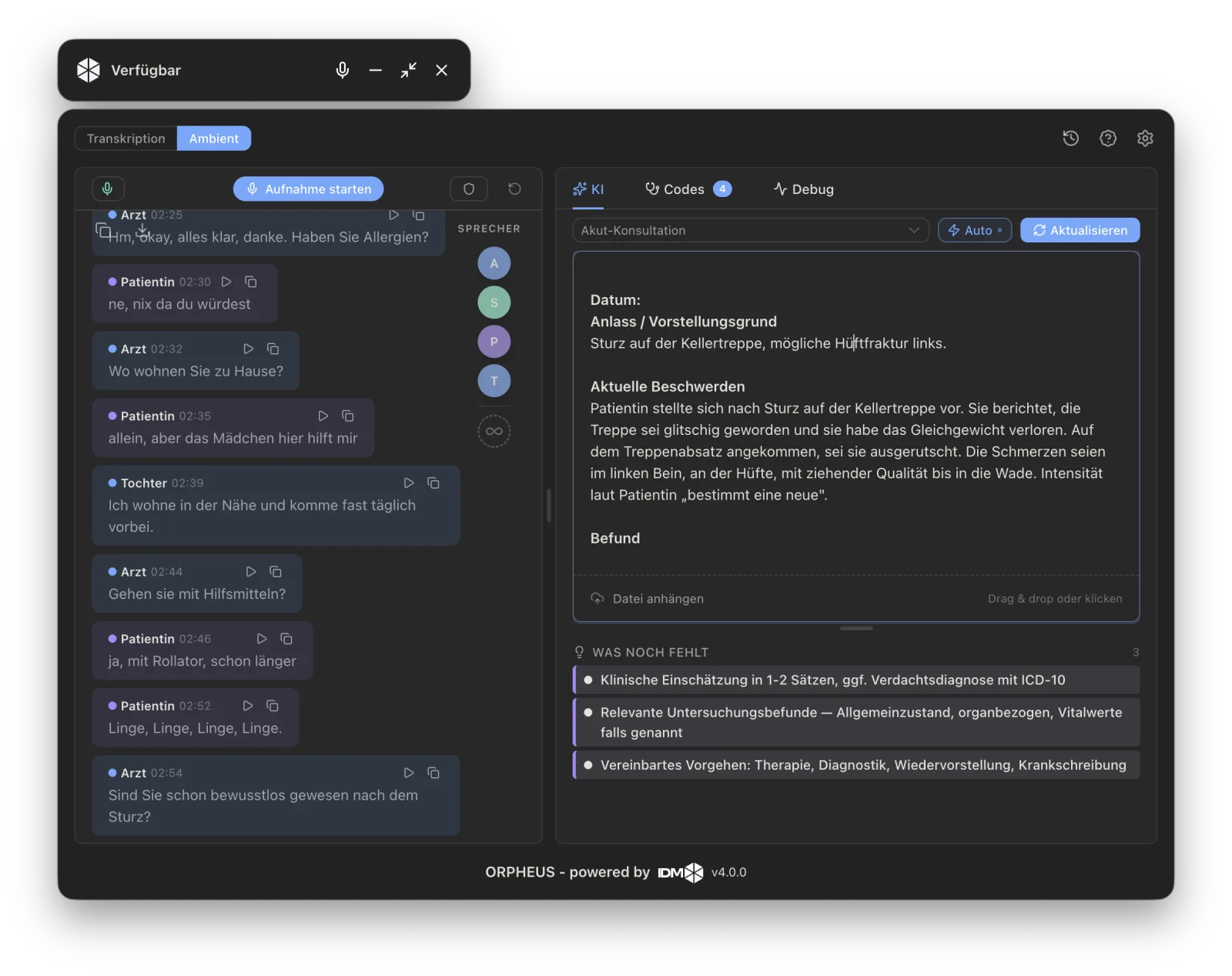
On the left, the separated conversation; on the right, the note generated from it. Under "What's still missing," ORPHEUS points to open items and matching ICD-10 codes while you're still speaking.
Templates: build once, use across the whole hospital
An ambient note is only as good as the structure it flows into. That's why this update ships with a public template library.
The system templates are ready to use out of the box, among them acute consultation, physician and findings letters, shift handover, and nursing documentation. You create your own templates the way you always have, and now you share them with your team: what one colleague builds, the whole ward uses. And so that large hospitals can quickly find the right template in a growing collection, there are tags of your own: by specialty, by ward, by language, whatever fits your organization. You can also share templates publicly between our customers, so that we all support each other in everyday practice.
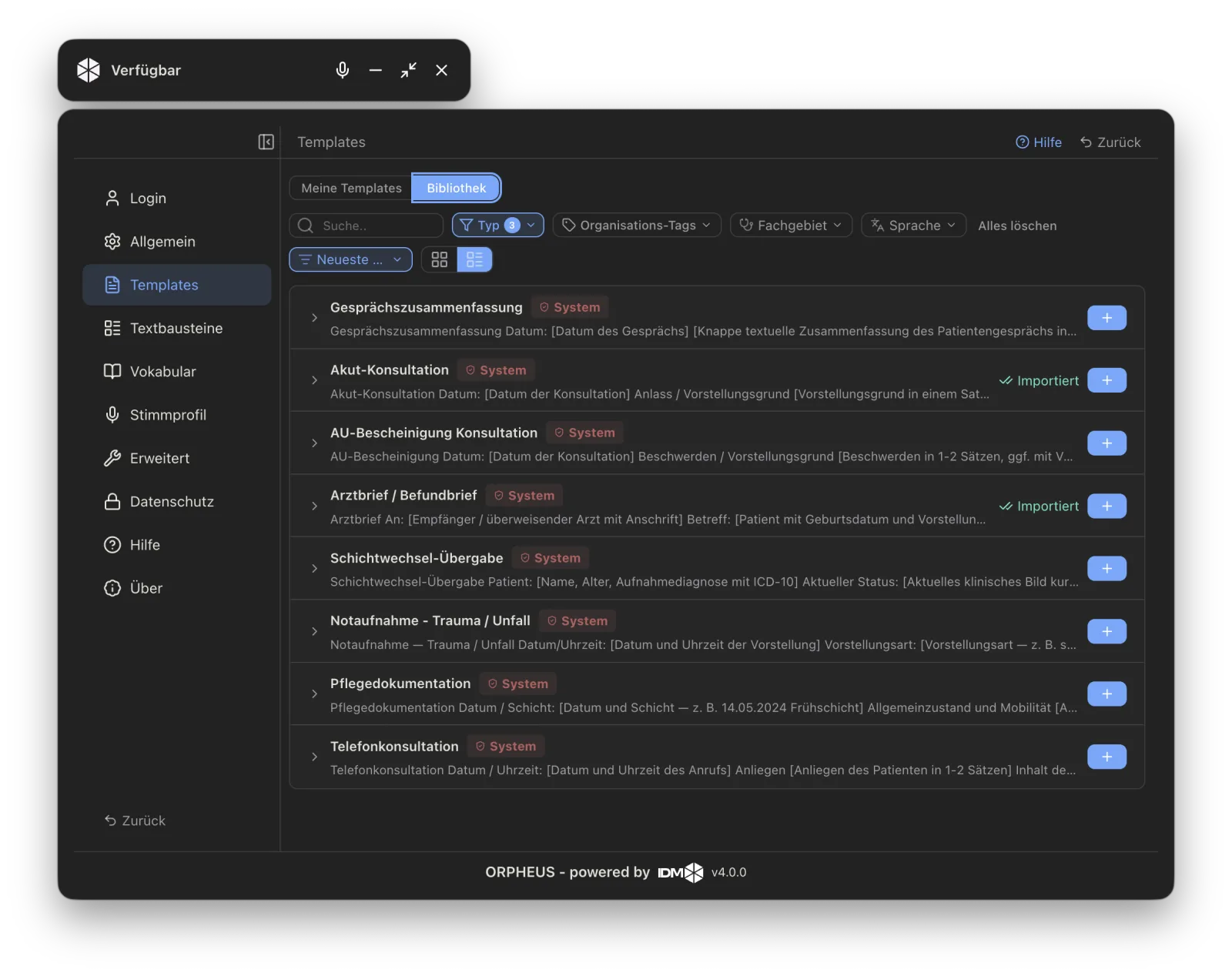
The template library: system templates, shared team templates, and tags for fast filtering.
Two more features fit right in. ORPHEUS suggests matching ICD codes, drawn from what's been documented. It's a suggestion, not a decision. The call stays with you. And with OCR upload you can bring in what was never spoken: upload screenshots and documents, ORPHEUS reads the text and pulls it in.
Mobile: ORPHEUS in your coat pocket
ORPHEUS is now a native app, in the Apple App Store and on Google Play.
You sign in with your usual ORPHEUS credentials. Your history syncs with the desktop client: whatever you record on the go is waiting for you back at your desk. And ORPHEUS works as a keyboard, in email and in any other app. Medical dictation, right where you'd be typing anyway. Between rounds, on the way to the office, on weekend duty.
Why we build this
We build ORPHEUS out of the clinic, out of Hamburg. Sovereign, nonprofit medical AI, developed where it's used, independent of the big tech companies. It's the condition for patient data being processed in Germany, and for medicine deciding how its own tools work.
And that has a concrete consequence: every use makes the system better. Every template, every correction, every conversation strengthens an infrastructure that belongs to all the clinics taking part. Your data is not a business model for us. As a non-profit, we put surpluses directly into our charitable mission. We build a tool with you that serves care, and one that gets better the more hospitals carry it. So please pass ORPHEUS on to your colleagues. That helps our mission.
How to get started
Restart your ORPHEUS client once. It updates to version 4.0 automatically. You'll find the templates in the ORPHEUS portal, along with the new system library. And you can download the mobile app from the App Store or on Google Play.
About the author

Nils Schweingruber
CEO & Mitgründer, IDM gGmbH
Facharzt für Neurologie, CEO und Mitgründer der IDM.
LinkedIn →