How AI documents the doctor-patient conversation
Nils Schweingruber
CEO & Mitgründer, IDM gGmbH
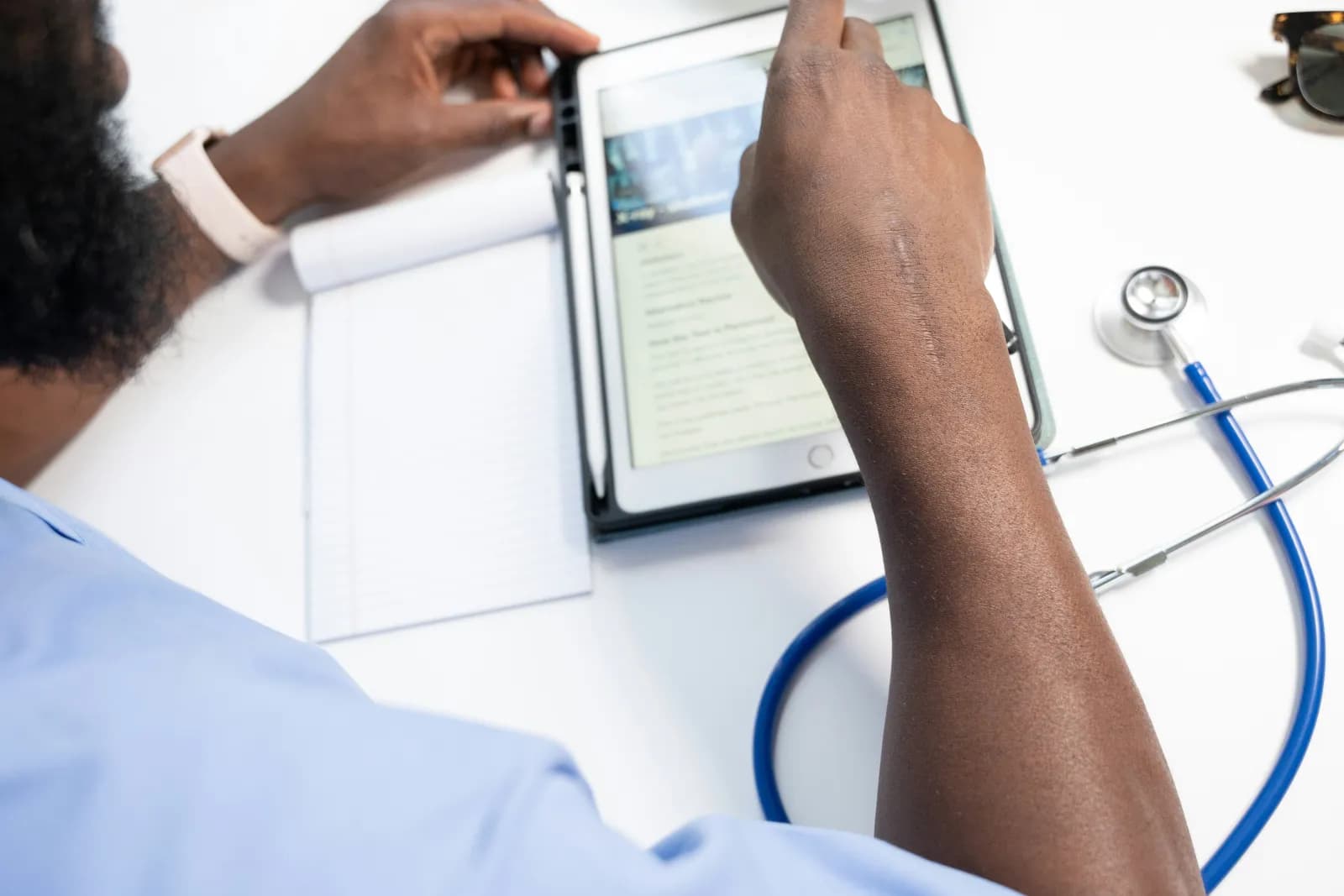
Documentation eats up a large part of the working day in hospitals and practices. Every finding, every progress note, every discharge letter has to be written, usually after the consultation, often late in the evening. Ambient documentation turns this around. The conversation itself becomes the note, while it happens.
What ambient documentation means
Classic speech recognition waits for a dictation. You speak a sentence, the system writes it down. Ambient documentation waits for nothing. You hold your conversation as you normally would, with the patient, with relatives, with colleagues at the bedside. In the background, an AI listens and turns it into a structured clinical note.
The difference is not gradual, it is categorical. The tool turned your words into text. Now an assistant follows the conversation and understands which parts belong in the record.
How the technology works
Three things happen at once. The AI separates the speakers, this is called diarisation, and knows who is the physician, who is the patient, who is a relative. It maps what it hears onto a template, the structure your documentation already follows. And it recognises what is still missing for that template, the open question about medication or the value that has not yet come up.
At the end there is no audio track to transcribe, but a draft that already follows the structure of your documentation. You read it, correct it, sign it off. The decision always stays with you.
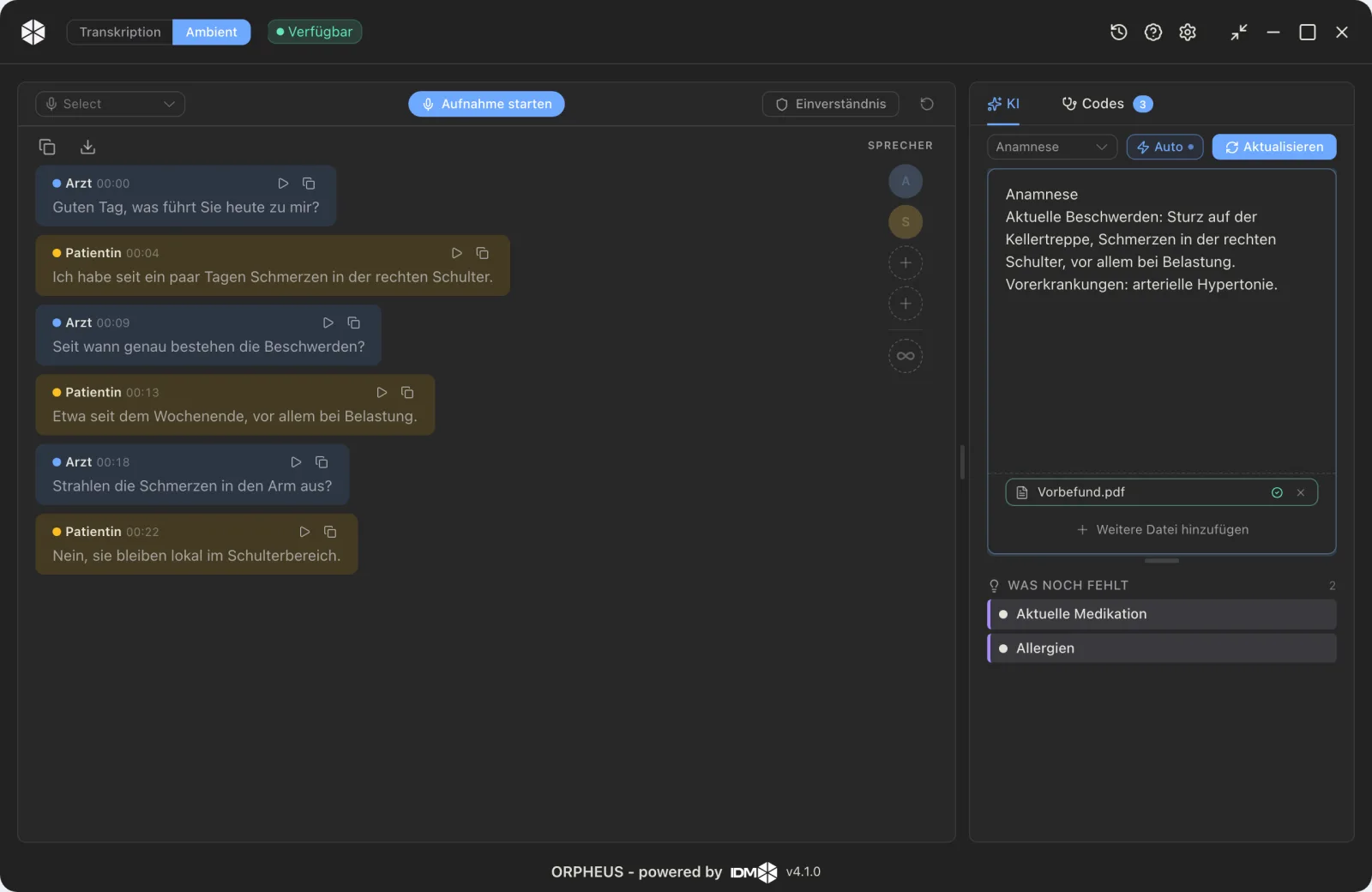
On the left the conversation separated by speaker, on the right the structured note. Under "what's still missing" the system points to open items while you are still talking.
Ambient or classic dictation
Both have their place. For the quick finding in between, dictation remains unbeatable, one sentence, one result. For the long conversation, the admission interview, the ward round, the psychiatric exploration, ambient plays to its strength. No one has to type alongside the patient anymore or memorise notes for later. Good systems do both and let you switch between modes in everyday use. And what matters in medical speech recognition applies to both modes.
What matters in Germany
A conversation between doctor and patient is among the most sensitive data there is. Anyone introducing ambient documentation should ask three questions.
Where is the data processed? A solution that sends the conversation to a US cloud is not an option for most institutions. Processing in Germany or in your own data centre is the safe route.
Is my data used to train someone else's models? The answer has to be no, demonstrably and contractually.
How is consent handled? The patient must know that the conversation is being recorded. That is part of the process, not an afterthought.
GDPR compliance, hosting in Germany, a clean data processing agreement and the option to run on premises are not extras here. They are the precondition.
For practice and hospital
The benefit is the same in both worlds, the context is not. In the practice and the MVZ, ambient relieves the whole team, from the physician to the medical assistant to therapists and nurses. In the hospital it carries through admission, ward round, handover and discharge. What matters is that the note lands where it is needed, directly in the practice or hospital information system and not in yet another isolated window.
Where ORPHEUS stands
ORPHEUS is the medical AI speech recognition built by IDM gGmbH, the non-profit spin-off of University Medical Center Hamburg-Eppendorf. Since version 4.0, ORPHEUS documents the conversation ambiently, based on a shared template library, with speaker separation, hints about what is still missing, and suggestions for matching ICD codes. It runs hosted in Germany and, on request, in your own data centre, designed for GDPR-compliant use. More than 40 hospitals, four university hospitals and over 500 practices use it every day.
We build ORPHEUS as a non-profit and out of the clinic itself, with a commitment to digital sovereignty. The data stays in Germany, and medicine decides how its tools work. For a concrete look at ambient in ORPHEUS, see ORPHEUS now understands whole conversations. The full solution is on the ORPHEUS product page.
About the author

Nils Schweingruber
CEO & Mitgründer, IDM gGmbH
Facharzt für Neurologie, CEO und Mitgründer der IDM.
LinkedIn →Related Posts
ORPHEUS now understands whole conversations
ORPHEUS now writes along while you talk to your patient. Ambient documentation, a template library, and mobile apps. Our biggest update yet.
engineeringORPHEUS Update 3.2.0 is Here
Templates, vocabulary, text snippets with jump marks, and English speech recognition. Everything new in ORPHEUS 3.2.0.